If you want to know more about Seasonal Colour Analysis 101 then this post is for you…
- Introduction
- Technical Terms
- What is Colour Analysis
- What is Seasonal Colour Analysis
- A brief Timeline of Colour Analysis
- A Personal Consultation
- Training in Seasonal Colour Analysis
- Further Reading and Downloads
- Conclusions
Introduction
Colour is all around us. Colour is light – for without light there can be no colour. It impinges on our every waking moment. It has fascinated man since the earliest times and yet it is often taken for granted. It affects us psychologically and emotionally. It can make us excited, or peaceful, uplifted or gloomy. Studies have shown that blood pressure can be affected by the response to colour and it’s no surprise that red is used in in so many food logos – as it can stimulate appetite.
Although colour had long been understood and used by artists for hundreds of years, it wasn’t until the early 70’s that people started to understand the relationship between the colours that people choose to wear and their impact on those around them. And so the concept of using colour in personal image and presentation started to grow as a concept and Colour Analysis emerged as a service for individuals and as a tool for use by business professionals.Technical Terms to Know About Colour
It will help your understanding of Colour Analysis if you understand some of the terms that are used when describing colours. If you have one, it will help to look at a Grumbacher Colour Wheel while you are reading this section.
Picture coming soon…
You can find a good picture of one here. Alternatively you may wish to purchase one. Although if you are considering training in Colour Analysis with Imagination using the Colourflair method, you will receive one as part of your colour kit
HUE is a term often used simply to mean colour. It is that which distinguishes one colour from another.
The PRIMARY colours (or hues), Red, Yellow and Blue exist in their own right and are not a mixture of other colours, they are pure colours. All other colours (tones, shades and tints) are created by mixing primary colours together and by adding black or white. This is why some colours are particularly flexible, when it comes to colour analysis.
SECONDARY colours (or hues) are mixed from two primaries to make Orange, Green and Violet.
The INTERMEDIATE colours are mixed from unequal amounts of two primaries and they have double names like yellow-orange or blue-green.
VALUE is the lightness or darkness of a colour. White is given the Value 10 and Black has the Value 1 – there is a scale of grey in between these values.
TINTS are pure colours that have had white added to them. They are higher in value than the original colours from which they are made. Colours or hues with black added to them are lower in value than the original colours and are called SHADES. A pure colour that has had grey added to it is called a TONE and may be described as muted.
INTENSITY refers to how bright or dull a colour is.
MONOCHROMATIC harmonies use various values and intensities of one colour, or one colour with black and white. They are tasteful and reliable but can be rather monotonous.
ANALOGOUS harmonies use hues which are closely related to each other on the colour wheel e.g. blue, blue-green and green. They can be pleasing and restful combinations which help to set a mood.
COMPLEMENTARY harmonies use the colour which is directly opposite on the colourwheel, red and green, blue and orange etc. The term complementary comes from the fact that when combined as light, they contain between them, all the colours of which light is composed and therefore revert to white. These are bold combinations that work best if the value and intensity of the chosen hues are varied (e.g. navy blue and peach).
What is Colour Analysis?
Colour Analysis helps an individual to understand the colours that suit them best. These colours will not only compliment their complexion but also align with their personality and will help them present the best image of themselves and how they are perceived by other people.
The process compares the colours or pigments primarily in the skin, with colours which share similar characteristics. This is done by a technique known as “draping” whereby a selection of coloured materials or drapes are introduced in a sequence near to the face. The colours which bring balance and harmony to the individual are identified and a “FAN” or “SWATCH” of colours are usually provided to the individual as an aide memoire.
Knowing the colours that suit best, enables the individual to use colour to their advantage, to look healthier, often younger and more vibrant and at a functional level to plan their wardrobe with clothes that easily mix and match together, because they are in a similar colour palette.
What is Seasonal Colour Analysis?
Seasonal Colour Analysis is generally perceived to be the original method of colour analysis and is still used very effectively today. It is easily understood by both the consultant and client alike.
The colours are closely related to the seasons of the year in the Northern hemisphere, and so by dividing them by whether they were warm or cool and then into seasonal groups, they were easy to understand.
There are two warm and two cool seasons.
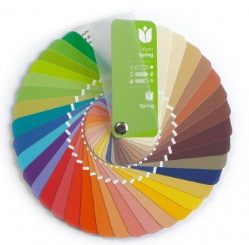
SPRING, has joyous, warm colours that welcome in the start to the year with a range of colours very close to the rainbow and reflecting what we see in gardens at that time of the year.
Then AUTUMN with the warm gold and muddy browns that we see on the trees as they lose their leaves.
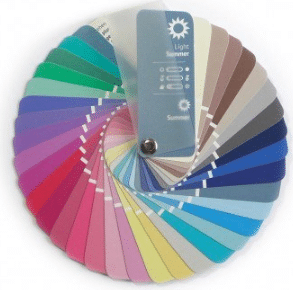
The cool colours are those of SUMMER, you might like to associate these colours with cool faded colours of flowers in the garden after a long hot summer.
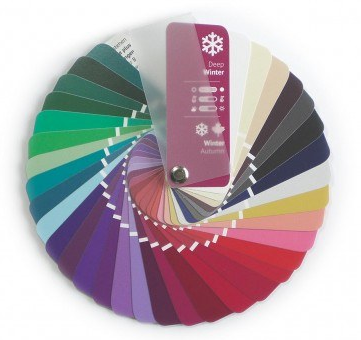
And finally, WINTER. This is a cold season (in the northern hemisphere) which lacks colour, and may be characterised by white snow on black trees.
Are there other methods of Colour Analysis?
Since the 80’s numerous authors have tried to refine the process of Colour Analysis and there are now many different methods. Probably the most well-known of these is the TONAL method.
What is the tonal method?
The tonal method analyses each colour characteristic according to its depth, undertone and clarity and selects the dominant one for each client. These are termed Deep, Light, Cool, Warm, Bright or Muted.
Why were other colour analysis methods invented?
Some say that the seasonal method system may not go far enough. In other words, because everyone is an individual, there is the potential for an infinite number of variation, that an individual could have, which may not fit neatly into just 4 seasonal categories. Because of this, since the 80’s authors have tried to extend the seasonal method to be more flexible and others have come up with new methods that do not base their nomenclature on the seasons.
Another argument is that the seasons differ in the north and south hemisphere and so the colours used in most seasonal systems are aligned with northern hemisphere countries.
A brief search on the internet will show that many people get completely confused by the Tonal concept and do not find it easy to understand. In our article “Seasonal or Tonal” we examine this issue further. You will see that in reality it is the Consultant with a special interest in colour that get hung up on the nomenclature. The reality is that is doesn’t matter what terms you use the outcome of a colour analysis are the same – to identify the better colours and to empower and give confidence to those who are less certain of colour and how to wear it or even use it in their homes. For most people it is enough to have basic information that they can easily act on, without getting into the detail which may overwhelm them. From that viewpoint the seasonal system is easiest to understand.
A Brief Timeline of Colour Analysis
There have been many people associated with the development and our current understanding of colour and colour analysis follow this link f if you would like to read more about the research that went into modern colour anaysis…
1810 Johan Wolfgang Von Goethe: Theory of Colours
1856 Michel Eugene Chevreul: The Principles and Harmony and Contrast in Colours
1882 Rudolph Steiner: Colour
1900 Albert Munsell: Colour Systems
1916 Wilhelm Ostwald: The Color Primer
1920 Johannes Itten: Painter and Professor at the Bauhaus Design Academy Cool and Warm
1940 Robert Dorr Color Key System
1977 Bernice Kentner: Colour Me a Season
1980 Carol Jackson Colour Me Beautiful
The Pros and Cons of Colour Analysis
There are generally few downsides to Colour Analysis. Although some sources suggest that it is limiting to have a prescribed selection of colours from which to choose your clothing or make up options.
Unfortunately, there is a lot of misunderstanding and incorrect information that is circulated both in printed matter and on the Internet. While it is true that generally the quality of Colour Analysis has improved in the last 40 years, there are still many inaccurate sessions.
I have met many ladies who had their “colours done”, as it is commonly called, some years previously and clearly their advice was incorrect. Imagine wearing “the wrong” colours for more than half of your life?
There are several books on the subject of Colour Analysis that have misunderstood the concept and give poor information. As I mention below – you cannot easily conduct your own Colour Analysis session and without a trained eye it is easy to miss the nuances that different colours bring to the complexion. You really are better off with a professional Personal Colour Analysis.
Personal Colour Analysis
If you have reached this page because you are interested in having a Personal Colour Analysis our advice would be to find a consultant through our website here Colourflair Colour Consultant
If we do not have a Colour Analysis Consultant in your area then google Colour Analysis with your locality and you will receive the local information which will help you to make a decision.
You should look for someone who is regularly doing colour analysis. Without regular practice your consultant will lose their expertise quite quickly and you will be unlikely to have an accurate result. This may be identified if you find someone who is charging very little. It may be a hobby for them. A full colour analysis from a practising consultant will cost at least £100 and in many areas in the UK you could expect to pay £125-£175 (January 2023).
Do not be tempted to have a group session either. Although it may be cheaper – we have already identified that this is a very individual process and result and therefore you should expect your consultants’ full attention and not share her time and expertise with others.
This is not something that you can easily do for yourself so using a self-help book, may not give you the correct results. So, although it is interesting to read about the subject, for an accurate analysis you need to pay for a professional clour analysis session.
How to Train in Colour Analysis
If you would like to take this information to the next stage there are several things that you can do immediately.
The first is to find a training course that meets your needs. Here are some questions that you might like to ask yourself…
Do I want to learn more for self-improvement or am I going to use the information in a business setting?
If you are going to use the information in a business environment – Are you planning to use the information to enhance the skills and knowledge set that you already have or are you planning to start a business centred around colour analysis?
What type of learner am I? Our article what’s your learning style is linked below….
These questions will help you decide how much you would like to pay for your training and whether you can easily re-coup your training costs, should you need to. Also consider how much time you may have to study each week/month
Here are some links to blog article that you may find helpful:
How to Recoup your Colour Analysis Training Costs
Cheap Colour Consultant Training
How much does it cost to train in Colour Analysis?
How to Get 30 Clients in 30 Days for Colour Analysis
Depending on your Learning style you may prefer a classroom environment. This is usually the most expensive option as you may have travel and accommodation costs to factor in, as well as the course fees.
Home study provides a more cost-effective option. Your training company provider should offer assignments for submission and assessment and you should look for one with a personal tutor too. Your tutor will give invaluable feedback and be able to guide you as you become a successful Colour Analyst.
Day classes and short courses: these are also cost-effective options, but generally only serve those who want to know more about the subject. While you can understand the concept and the practice in a training day, you will not develop the skill needed to offer a Colour Analysis service. Colour Analysis needs to be practiced. Draping one or two people in a class in not enough.
On-line courses are attractive because they too are generally a cost-effective option – but without assignments and assessments that involve more than just multiple choice, will only provide more information about the concepts of Colour Analysis.
The Advanced Colour Analysis Diploma offered by Training with Imagination and Colourflair is a home study course in seasonal colour analysis with a personal tutor, available by phone, email or skype/zoom. As well as the four basic seasons there is a 16 fan system which tailors the swatches to the individuals skin tone. There is an Association for Consultants to join which gives ongoing training, updates and business support. This is not a Franchise.
The Colourflair system does not rely solely on the Consultants expertise as this is a holistic approach in which several factors are taken into consideration – to establish an accurate result. Our students are confident in their learning to see some testimonials please click here.
Our course prospectus is here
What kit will I need?
At the very least your training course should provide you with the opportunity to buy drapes and a starter selection of fans or swatches.
At Training with Imagination we give you all the items that you will need to conduct a Colour Analysis session – include drapes, fans and a selection of miscellaneous items that you will use not only during your training, but also when you are a qualified consultant.
Fans/Swatches
Training with Imagination offers a variety of fans and swatches in the Trade Price List. Some are suitable for Personal Seasonal Colour Analysis, others have a tonal variation too and some can be used in small classes and workshops. Please contact us if you would like a copy of the Price List.
Can I make a successful business out of Seasonal Colour Analysis?
The short answer is Yes you can. The longer answer is that as with any business, it is not enough to have the practical skills. As well as being well trained in the technique of Colour Analysis – you will find that there are other skills that you will need. Several of these are directly related to business skills. Some of these you can learn or outsource if you have budget. Perseverance and commitment are also required if you are starting a new venture into the business world as a sole trader
Is colour analysis for me?
If you love colour then you will really enjoy finding out more about Colour Analysis and working with clients. If you prefer working in a team environment – then this may not be for you – and you may wish to find another opportunity that enables you to work in a company or with a team. Most Colour Analysis professionals run their own business and work as Sole Traders.
Colour Analysis and Covid-19
As life gets back to normality (although slowly) you can find out more here about Colour Analysis and Covid-19 – how our training resources are already updated for new students and Information has been disemminated to our qualified consultants.
Further Reading
Our course notes include everything that you will need to train as a successful Colour Analyst. However, our course does include a reading list if you wish to take your knowledge on certain aspects of the Colourflair colour analysis system further. Here are just a few to get you started…
Color Me A Season: A Complete Guide to Finding Your Best Colors and How to Use Them
A Rainbow in Your Eyes: Yes, You Can Find Your Colors and for Others Too
Next Steps
If you’ve been inspired to find out more about Colour Analysis and would like to know more about training as a Consultant, you can find more details in our course prospectus by entering your email at the top of the page/
You will be sent a short series of emails with additional information to help you make a decision on our course. You can unsubscribe at any time.
In conclusion, Seasonal Colour Analysis can be a life changing experience for a person. It offers greater understanding of the colours that suit an individual best – giving them confidence and an ability to use colour to their advantage. Professional skills in Colour Analysis can be used as the basis for a successful business.
For more information about our quality training course, please request our information pack. This includes information about our trade items and Colour Kits and ongoing training and business support.
Article Updated February 2023
Further Reading:
Colour in itself is a huge topic upon which many very interesting books have been written. If you would like more general information about Colour, then a quick google search will provide you with books and topics on the subject. A search using Colour as the keyword on Amazon (books) will bring up a large selection of currently published books. The links below are a small selection on books that have been written on the subject and that may provide you with a good starting point:
Colour:
Colour – various Editors (Grange Books)
The Secret Lives of Colour – Kassia St Clair
Colour Psychology:
Color Psychology & Color Therapy – Faber Birren (Citadel Press)
The Beginner’s Guide to Colour Psychology – Angela Wright (Kyle Cathie)
In our BLOG we have a number of posts that you may also find interesting:
With inspiration from the Pantone Colour Institute:
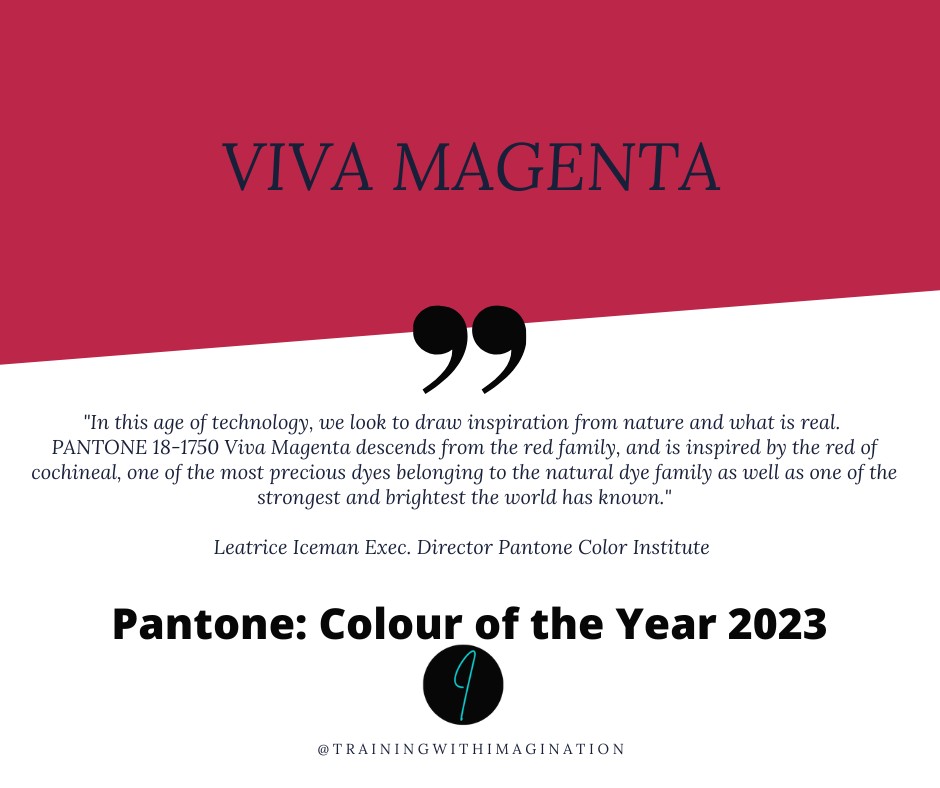
Viva Magenta The Pantone Colour of 2023
Veri Peri The Pantone Colour of 2022
Ultimate Grey and Illuminating the colours of 2021
Spring/summer 2021 colour palettes
Pantone Colour of 2019 Living Coral
The Pantone Colour 2018 Ultraviolet
Add Colour to their Wardrobe ~ Greenery
Marsala – Pantone Colour of 2015
Radiant Orchid ~ Pantone Colour of 2014
Emerald Green ~ The Colour of 2013
And more general topics:
Periwinkle Blue In the News 2019
Silver~key colour trend spring 2016
BOOK REVIEW
The Little Book of Colour Karen Haller
COLOUR QUIZ
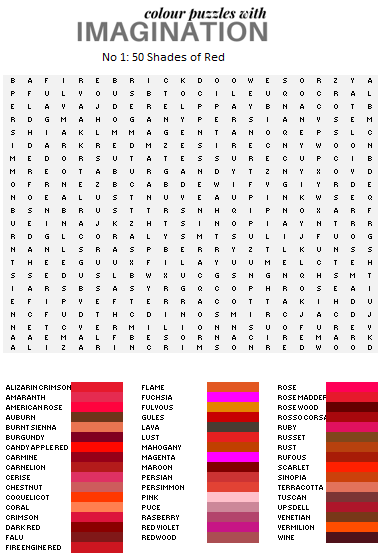
For those of you who’d like to test your colour knowledge here is a fun wordsearch on the Colour Red
50 Shades of Red Word Search ~DOWNLOAD
Request our course information
To find out about training in colour analysis request our details in the form below…